
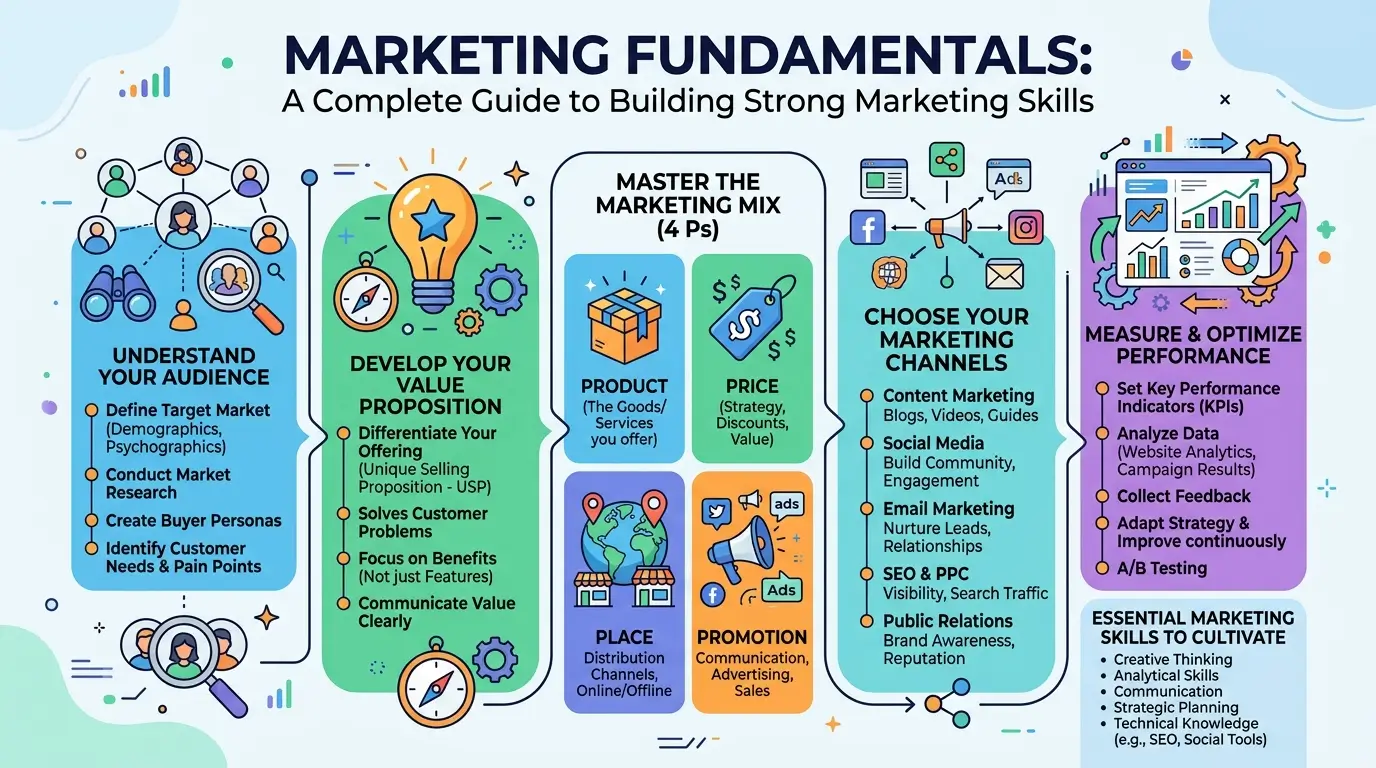
Marketing is one of the most important functions of any business. No matter how great a product or service is, success depends on whether people know about it, understand its value, and choose to buy it. This is where marketing plays a critical role.
Understanding marketing fundamentals helps businesses connect with customers, build strong brands, increase sales, and achieve long-term growth. Whether you are a business owner, student, entrepreneur, freelancer, or marketing professional, learning the basics of marketing provides a solid foundation for success.
In this comprehensive guide, we will explore the key marketing fundamentals, explain how they work, and discuss practical strategies that businesses use to attract and retain customers.
Table of Contents
ToggleWhat Are Marketing Fundamentals?
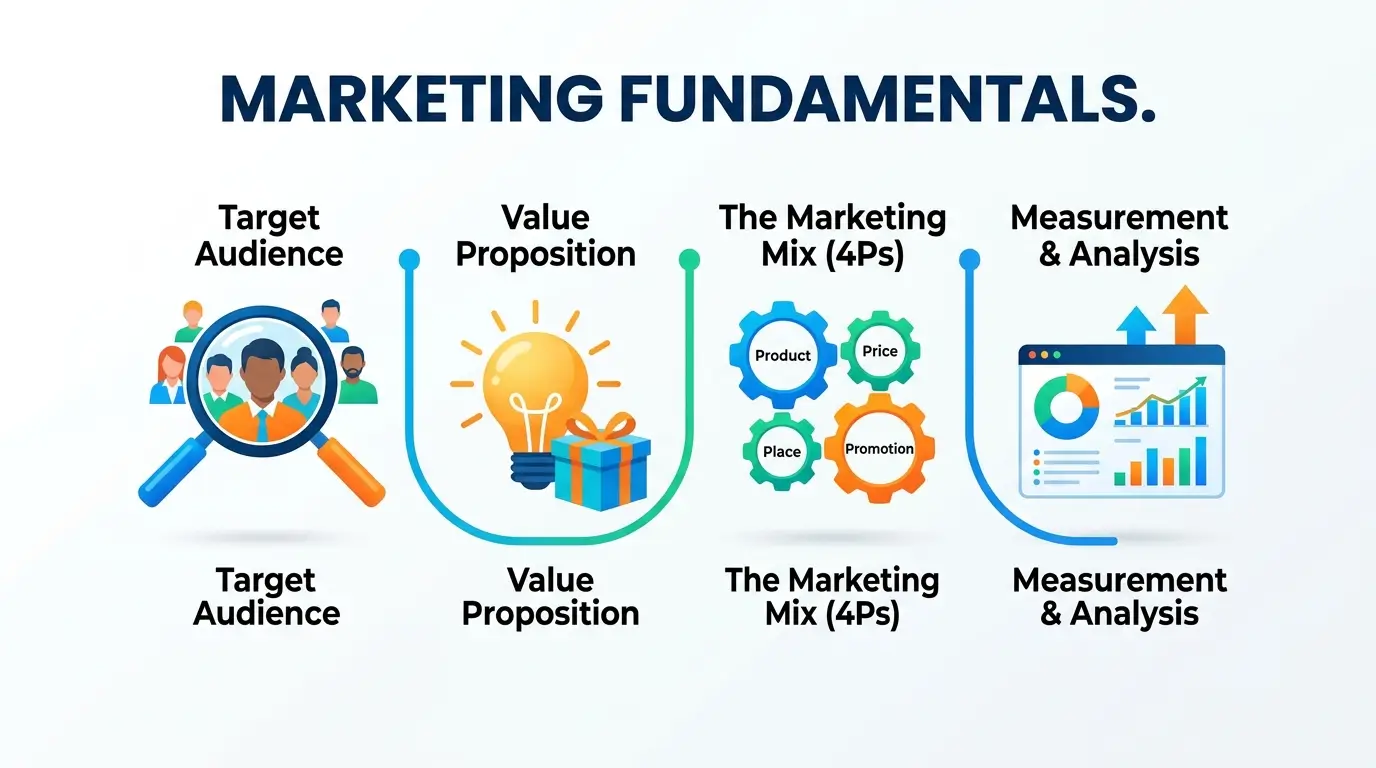
Marketing fundamentals are the core principles and concepts that guide how businesses identify customer needs, create valuable products or services, communicate with their audience, and generate sales.
At its core, marketing is about understanding people and providing solutions to their problems.
The main goal of marketing is not simply to sell products. Instead, it focuses on creating value for customers while helping businesses achieve their objectives.
Why Marketing Fundamentals Matter
Every successful marketing campaign is built on basic principles. Without understanding these fundamentals, businesses often struggle to:
- Reach the right audience
- Communicate effectively
- Build customer trust
- Generate consistent sales
- Create brand awareness
- Compete in crowded markets
Learning marketing fundamentals helps businesses make smarter decisions and use their resources more efficiently.
The Evolution of Marketing
Marketing has changed significantly over the years.
Traditional Marketing Era
In the past, businesses relied heavily on:
- Newspapers
- Magazines
- Radio
- Television
- Billboards
- Direct mail
These channels allowed companies to reach large audiences but offered limited targeting options.
Digital Marketing Era
Today, digital platforms have transformed how businesses market their products.
Popular digital channels include:
- Search engines
- Social media
- Email marketing
- Content marketing
- Mobile apps
- Online advertising
Digital marketing allows businesses to target specific audiences, measure performance, and adjust campaigns in real time.
Despite these changes, the core marketing fundamentals remain the same: understanding customer needs and delivering value.
Understanding the Marketing Concept
The marketing concept is a business philosophy that focuses on customer satisfaction.
Instead of asking, “How can we sell this product?” marketers ask:
- What do customers need?
- What problems do they face?
- How can we help solve those problems?
Businesses that adopt a customer-focused approach often achieve stronger growth because they build lasting relationships with their audience.
Key Elements of the Marketing Concept
Customer Focus
Customers should be at the center of every marketing decision.
Integrated Marketing
All marketing activities should work together to deliver a consistent message.
Profitability
Marketing should contribute to business growth and profitability.
Long-Term Relationships
Successful marketing focuses on building trust and loyalty over time.
The Marketing Mix: The Four Ps
One of the most important marketing fundamentals is the marketing mix, commonly known as the Four Ps.
1. Product
The product is what a business offers to customers.
Products can be:
- Physical goods
- Digital products
- Services
- Experiences
Successful products solve customer problems or fulfill specific needs.
Product Considerations
- Quality
- Features
- Design
- Branding
- Packaging
- Warranty
- Customer support
2. Price
Price represents the amount customers pay for a product or service.
Pricing strategies can influence:
- Sales volume
- Customer perception
- Profit margins
- Market positioning
Common Pricing Strategies
- Premium pricing
- Competitive pricing
- Penetration pricing
- Value-based pricing
- Discount pricing
3. Place
Place refers to how products reach customers.
Distribution channels may include:
- Retail stores
- E-commerce websites
- Marketplaces
- Direct sales
- Distributors
- Wholesalers
The goal is to make products easily accessible.
4. Promotion
Promotion involves communicating with customers and encouraging purchases.
Examples include:
- Advertising
- Public relations
- Social media marketing
- Email marketing
- Influencer marketing
- Sales promotions
Effective promotion increases awareness and drives customer action.
Understanding Your Target Audience
One of the most critical marketing fundamentals is knowing your audience.
Businesses cannot effectively market to everyone.
Instead, they must identify specific groups of people who are most likely to benefit from their products.
What Is a Target Audience?
A target audience is a group of consumers who share similar characteristics.
These characteristics may include:
- Age
- Gender
- Location
- Income
- Education
- Interests
- Lifestyle
- Purchasing behavior
Benefits of Audience Targeting
When businesses understand their audience, they can:
- Create better products
- Develop effective messages
- Improve advertising results
- Increase customer satisfaction
- Reduce marketing costs
Market Segmentation
Market segmentation involves dividing a larger market into smaller groups with similar needs.
Types of Market Segmentation
Demographic Segmentation
Based on factors such as:
- Age
- Gender
- Income
- Occupation
Geographic Segmentation
Based on location, including:
- Country
- Region
- City
- Climate
Psychographic Segmentation
Based on:
- Personality
- Values
- Interests
- Lifestyle
Behavioral Segmentation
Based on customer actions, including:
- Purchase history
- Brand loyalty
- Product usage
- Shopping habits
Segmentation helps businesses create more personalized marketing campaigns.
Branding Fundamentals
A brand is much more than a logo or company name.
A brand represents how customers perceive a business.
Strong branding creates recognition, trust, and loyalty.
Components of a Brand
Brand Name
The business name customers remember.
Logo
A visual symbol representing the company.
Brand Voice
The style and tone used in communication.
Brand Values
The principles that guide the business.
Customer Experience
Every interaction customers have with the company.
Why Branding Matters
Strong brands often enjoy:
- Higher customer loyalty
- Increased trust
- Greater market recognition
- Better customer retention
- Competitive advantages
Customer Value and Satisfaction
One of the most important marketing fundamentals is creating customer value.
What Is Customer Value?
Customer value is the perceived benefit a customer receives compared to the cost of a product or service.
Customers evaluate:
- Quality
- Convenience
- Features
- Price
- Service
When perceived value exceeds cost, customers are more likely to buy.
Customer Satisfaction
Satisfied customers often:
- Make repeat purchases
- Recommend the brand
- Leave positive reviews
- Become loyal customers
Businesses that consistently deliver value tend to outperform competitors.
Marketing Research Fundamentals
Marketing decisions should be based on data rather than assumptions.
Marketing research helps businesses understand:
- Customer preferences
- Market trends
- Competitor activities
- Industry changes
Types of Marketing Research
Primary Research
Collected directly from customers through:
- Surveys
- Interviews
- Focus groups
- Observations
Secondary Research
Uses existing information from:
- Industry reports
- Government data
- Academic studies
- Market analyses
Benefits of Marketing Research
Research helps businesses:
- Reduce risk
- Identify opportunities
- Improve products
- Understand customer behavior
Consumer Behavior Basics
Consumer behavior studies how people make purchasing decisions.
Understanding why customers buy helps businesses develop more effective marketing strategies.
Factors Influencing Consumer Behavior
Personal Factors
- Age
- Occupation
- Income
- Lifestyle
Psychological Factors
- Motivation
- Perception
- Beliefs
- Attitudes
Social Factors
- Family
- Friends
- Social groups
Cultural Factors
- Traditions
- Values
- Cultural influences
Businesses that understand consumer behavior can create more relevant marketing messages.
Content Marketing Fundamentals
Content marketing involves creating valuable information that attracts and engages an audience.
Popular content formats include:
- Blog articles
- Videos
- Podcasts
- Infographics
- Guides
- Case studies
Benefits of Content Marketing
Content marketing helps businesses:
- Build trust
- Educate customers
- Increase website traffic
- Generate leads
- Strengthen brand authority
For example, a fitness company may publish workout guides to attract potential customers interested in health and wellness.
Social Media Marketing Basics
Social media has become a powerful marketing channel.
Popular platforms include:
- TikTok
- X
- YouTube
Advantages of Social Media Marketing
- Direct customer interaction
- Brand awareness
- Audience engagement
- Cost-effective promotion
- Community building
Businesses can use social media to share updates, answer questions, and strengthen customer relationships.
Email Marketing Fundamentals
Despite the growth of social media, email remains one of the most effective marketing channels.
Benefits of Email Marketing
- Direct communication
- Personalized messaging
- High return on investment
- Customer retention
- Lead nurturing
Effective Email Marketing Practices
- Write clear subject lines
- Personalize messages
- Provide valuable content
- Use strong calls to action
- Maintain consistent communication
Email marketing continues to play a key role in modern marketing strategies.
Digital Advertising Basics
Digital advertising helps businesses reach targeted audiences online.
Popular Advertising Channels
Search Advertising
Ads displayed in search engine results.
Social Media Advertising
Paid promotions on social platforms.
Display Advertising
Visual banner ads shown across websites.
Video Advertising
Promotional videos shown before or during content.
Benefits of Digital Advertising
- Precise targeting
- Fast results
- Flexible budgets
- Performance tracking
Businesses can optimize campaigns based on real-time data.
Marketing Metrics and Performance Measurement
Successful marketing requires measuring results.
Key Marketing Metrics
Website Traffic
Tracks visitor numbers.
Conversion Rate
Measures how many visitors complete desired actions.
Customer Acquisition Cost
Calculates the cost of gaining new customers.
Customer Lifetime Value
Estimates long-term customer revenue.
Return on Investment
Measures profitability of marketing efforts.
Tracking these metrics helps businesses improve performance over time.
Relationship Marketing
Relationship marketing focuses on building long-term customer connections rather than pursuing one-time sales.
Benefits of Relationship Marketing
- Increased loyalty
- Repeat purchases
- Stronger trust
- Positive referrals
- Higher customer retention
Businesses that prioritize relationships often enjoy sustainable growth.
Common Marketing Mistakes to Avoid
Even experienced marketers make mistakes.
1. Ignoring Customer Needs
Marketing should always focus on solving customer problems.
2. Weak Branding
Inconsistent branding can confuse customers.
3. Poor Audience Targeting
Marketing to the wrong audience wastes resources.
4. Lack of Research
Assumptions often lead to poor decisions.
5. Ignoring Data
Analytics provide valuable insights for improvement.
6. Inconsistent Communication
Regular engagement helps maintain customer interest.
Future Trends in Marketing
Marketing continues to evolve rapidly.
Artificial Intelligence
AI helps automate tasks and improve personalization.
Personalization
Customers increasingly expect tailored experiences.
Video Content
Video continues to dominate online engagement.
Voice Search
Voice-enabled devices are changing search behavior.
Customer Experience
Businesses are investing more in seamless customer journeys.
While technology evolves, the core marketing fundamentals remain essential.
Practical Steps to Learn Marketing Fundamentals
If you want to build strong marketing skills, start with these steps:
- Learn basic marketing concepts.
- Study successful brands.
- Understand customer behavior.
- Practice content creation.
- Learn digital marketing tools.
- Analyze marketing campaigns.
- Track performance metrics.
- Stay informed about industry trends.
Consistent learning and practice are key to becoming an effective marketer.
Conclusion
Understanding marketing fundamentals is essential for anyone involved in business, entrepreneurship, or brand growth. These core principles provide the foundation for attracting customers, building relationships, and creating long-term success.
From understanding target audiences and market segmentation to mastering branding, customer value, content marketing, and performance measurement, each element plays an important role in a successful marketing strategy.
While marketing tools and technologies continue to evolve, the fundamental goal remains the same: understanding customer needs and delivering value. Businesses that master these fundamentals are better positioned to compete, grow, and build lasting connections with their audiences.
Whether you are launching a new business, managing an established brand, or starting a career in marketing, investing time in learning marketing fundamentals will provide knowledge and skills that remain valuable for years to come.