
Introduction
In today’s digital world, face recognition and facial analysis technologies have become an important part of our daily lives. From unlocking smartphones to enhancing online security, facial recognition tools are transforming the way people interact with technology. One platform that has gained attention in this field is iSpyFace.
iSpyFace is designed to help users analyze facial features, compare faces, and explore advanced face recognition capabilities. Whether you are interested in security, identity verification, entertainment, or digital research, iSpyFace offers a range of tools that make facial analysis easier and more accessible.
This guide explores everything you need to know about iSpyFace, including its features, benefits, applications, advantages, limitations, and future potential.
What is iSpyFace?
iSpyFace is a facial analysis and recognition platform that uses advanced algorithms to examine facial characteristics from images. The system can identify unique facial patterns, compare facial structures, and provide insights based on visual data.
The platform utilizes artificial intelligence and machine learning technologies to process images and generate accurate facial assessments. By analyzing different facial landmarks, iSpyFace can detect similarities and differences between faces with impressive precision.
As facial recognition technology continues to evolve, tools like iSpyFace are becoming increasingly valuable for both personal and professional use.
How Does iSpyFace Work?
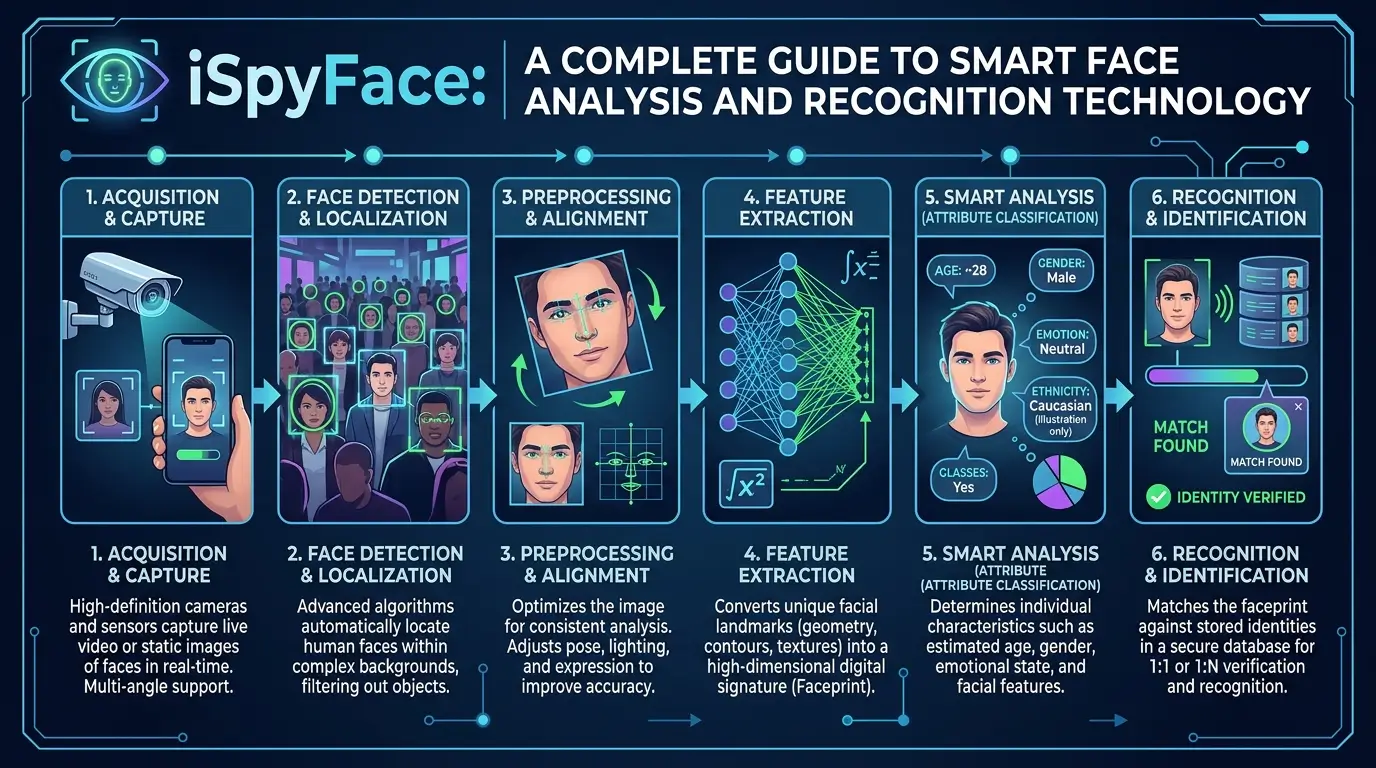
The technology behind iSpyFace relies on sophisticated facial recognition systems that analyze various facial features.
Image Upload
Users begin by uploading an image or photograph into the system. The image serves as the basis for analysis.
Facial Detection
The software identifies the face within the image and isolates important facial landmarks such as:
- Eyes
- Nose
- Mouth
- Jawline
- Forehead
- Eyebrows
Feature Mapping
The platform creates a digital representation of the face by measuring distances and relationships between facial landmarks.
Comparison and Analysis
Once the facial map is generated, the system compares it against available data or performs specific analyses depending on the user’s objective.
Result Generation
The final report may include:
- Facial similarity scores
- Feature comparisons
- Face matching results
- Visual analysis summaries
This process typically takes only a few seconds.
Key Features of iSpyFace
One reason for the growing popularity of iSpyFace is its diverse set of features.
Advanced Facial Recognition
The platform can identify facial characteristics with high accuracy using modern AI-powered recognition systems.
Face Comparison
Users can compare two or more images to determine facial similarities and differences.
User-Friendly Interface
The platform is designed with simplicity in mind, making it accessible for beginners and professionals alike.
Fast Processing Speed
Most analyses are completed within seconds, allowing users to receive quick results.
AI-Powered Analysis
Artificial intelligence continuously improves recognition accuracy and performance.
Multi-Purpose Applications
The platform supports various use cases across multiple industries.
Benefits of Using iSpyFace
There are numerous benefits associated with using iSpyFace.
Improved Accuracy
Advanced algorithms help reduce errors and increase recognition precision.
Enhanced Security
Facial recognition technology provides an additional layer of security compared to traditional authentication methods.
Easy Accessibility
Users can perform facial analysis without requiring specialized technical knowledge.
Time Savings
Automated recognition processes significantly reduce manual work.
Better User Experience
Fast and reliable analysis improves overall convenience.
Scalability
The technology can handle large volumes of images efficiently.
Applications of iSpyFace
The flexibility of iSpyFace allows it to be used in various fields.
Identity Verification
Organizations can use facial recognition to verify user identities.
Common examples include:
- Account verification
- Online registrations
- Digital onboarding
- Secure logins
Security Systems
Facial recognition plays an important role in modern security infrastructure.
Applications include:
- Access control
- Surveillance systems
- Visitor management
- Restricted area monitoring
Social Media and Entertainment
Many users explore face comparison tools for fun and entertainment purposes.
Examples include:
- Celebrity look-alike searches
- Face matching games
- Personal facial analysis
Research and Development
Researchers often use facial analysis technologies for academic and scientific projects.
Business Applications
Companies can integrate face recognition systems into their operations to improve security and customer experiences.
Why Facial Recognition Technology Matters
Facial recognition technology has become one of the fastest-growing areas of artificial intelligence.
According to industry reports, the global facial recognition market has experienced significant growth over the past decade and is expected to continue expanding as organizations seek more secure and efficient identification methods.
Several factors contribute to this growth:
- Increasing security concerns
- Digital transformation initiatives
- Advances in artificial intelligence
- Improved computing power
- Growing demand for contactless authentication
Platforms like iSpyFace represent this technological evolution by making advanced facial analysis more accessible.
Advantages of iSpyFace Over Traditional Methods
Traditional identification methods often rely on passwords, identification cards, or manual verification processes.
iSpyFace offers several advantages:
Contactless Verification
Users can verify identities without physical interaction.
Faster Authentication
Facial recognition can complete authentication within seconds.
Increased Convenience
There is no need to remember complex passwords.
Reduced Human Error
Automated analysis improves consistency and accuracy.
Enhanced Efficiency
Organizations can streamline verification procedures.
Understanding Facial Analysis Technology
Facial analysis involves much more than simply identifying a face.
Modern systems evaluate numerous facial characteristics, including:
Geometric Features
These include measurable distances between facial landmarks.
Structural Characteristics
The system examines overall facial structure and proportions.
Pattern Recognition
AI identifies patterns that distinguish one face from another.
Deep Learning Models
Advanced neural networks improve recognition accuracy over time.
The combination of these technologies allows iSpyFace to deliver reliable results.
Who Can Use iSpyFace?
One of the strengths of iSpyFace is its broad appeal.
Individual Users
People interested in facial analysis can explore the platform for personal use.
Students
Students studying technology, artificial intelligence, or computer vision may find facial analysis tools educational.
Businesses
Organizations seeking enhanced security solutions can benefit from facial recognition systems.
Researchers
Academic professionals often use facial recognition technologies in research projects.
Technology Enthusiasts
Anyone interested in AI-powered innovations can explore the capabilities of iSpyFace.
Tips for Getting Accurate Results
To maximize accuracy when using iSpyFace, users should follow several best practices.
Use High-Quality Images
Clear images generally produce better results.
Ensure Proper Lighting
Good lighting helps improve facial feature detection.
Avoid Obstructions
Faces should not be covered by objects or excessive shadows.
Use Recent Photos
Current images often provide more reliable comparisons.
Maintain Image Clarity
Blurry or distorted photos may affect analysis quality.
Potential Challenges and Limitations
While facial recognition technology is impressive, it is not perfect.
Image Quality Issues
Poor-quality photos can reduce accuracy.
Environmental Factors
Lighting conditions may impact results.
Facial Changes
Significant changes in appearance can affect recognition performance.
Technical Constraints
Different systems may produce varying levels of accuracy.
Understanding these limitations helps users maintain realistic expectations.
Privacy Considerations
As facial recognition technology grows, privacy remains an important topic.
Users should consider:
- How images are stored
- Data protection practices
- User consent requirements
- Security measures
- Responsible technology usage
Organizations using facial analysis tools should prioritize transparency and ethical practices.
Future of iSpyFace and Facial Recognition
The future of facial recognition technology appears promising.
Emerging developments may include:
Greater Accuracy
Advanced AI models continue to improve recognition performance.
Faster Processing
Improved hardware and algorithms reduce analysis times.
Better Security Features
Enhanced safeguards help protect user data.
Expanded Applications
New industries are adopting facial recognition solutions.
Smarter Automation
AI-powered systems are becoming increasingly intelligent and efficient.
As technology advances, platforms like iSpyFace are likely to offer even more sophisticated capabilities.
Common Use Cases for iSpyFace
Below are some practical situations where iSpyFace may be useful:
- Facial similarity analysis
- Digital identity verification
- Security monitoring
- Research projects
- Educational demonstrations
- Technology testing
- Personal face comparisons
- AI experimentation
Its versatility makes it suitable for various personal and professional purposes.
Frequently Asked Questions
Is iSpyFace easy to use?
Yes. Most users can upload images and receive analysis results without technical expertise.
Can iSpyFace compare two faces?
Yes. Face comparison is one of the platform’s primary functions.
Does iSpyFace use artificial intelligence?
Yes. The platform relies on AI and machine learning technologies for facial analysis.
Is facial recognition technology accurate?
Modern systems can achieve high accuracy when provided with quality images and proper conditions.
Can businesses use iSpyFace?
Many organizations can benefit from facial recognition and analysis technologies for security and verification purposes.
Conclusion
iSpyFace represents a modern approach to facial analysis and recognition technology. By combining artificial intelligence, machine learning, and advanced image processing, the platform offers powerful tools for face comparison, identity verification, and facial feature analysis.
As digital security and AI-driven solutions continue to evolve, facial recognition technologies are becoming increasingly important across multiple industries. iSpyFace provides users with a convenient and efficient way to explore these capabilities while benefiting from fast processing, user-friendly functionality, and intelligent analysis.
Whether you are a technology enthusiast, researcher, student, or business professional, iSpyFace demonstrates how facial recognition technology can simplify complex identification tasks and support a wide range of applications in today’s digital landscape.